
Running a Sex Offender Check in James City County
The official starting point is the Virginia Sex Offender and Crimes Against Minors Registry. Virginia State Police runs that public system, and searches are free without an account. Use the county option when the goal is geographic awareness within James City County. Use a name or SOR number when checking a specific official record. The search is a public-notification tool, not a general criminal history report. It shows people and information made public under the Registry Act, while court files and the VSP SP-167 process answer different questions.
Before searching, gather the most reliable fact available. A full name helps distinguish results, while an SOR number points to one state registration record. An address, city, ZIP code, or county can support a location search. Check the profile's status, qualifying offense, conviction jurisdiction, tier, and verification details separately. A map pin is only an aid. It may be approximate, and a Williamsburg mailing address does not settle whether the location is in James City County or in the separate City of Williamsburg.
When a search crosses state lines, repeat it through the federal search layer. When a record looks wrong, contact the agency that owns it. James City County Police can give current local reporting instructions, while the VSP Registry Unit handles the state record. Emergencies still go to 911.
James City County Registry Boundaries
The word “Williamsburg” creates the main local search trap. James City County contains no incorporated city or town, yet its police headquarters, courthouse, jail, and many homes use Williamsburg postal addresses. The independent City of Williamsburg is legally separate. A city search may therefore mix postal geography with locality boundaries, while a county search can exclude nearby city addresses that a family may still consider close.
Use more than one geographic path when location matters. First choose James City County from the county field. Then try the relevant ZIP or street address and inspect the source profile. If a marker lies near a boundary, confirm the official locality instead of relying on the mailing line alone. The Virginia Registry Act explains what the state collects and releases.
The official Virginia Code page also shows the law behind the system. The image below comes from that Registry Act source.
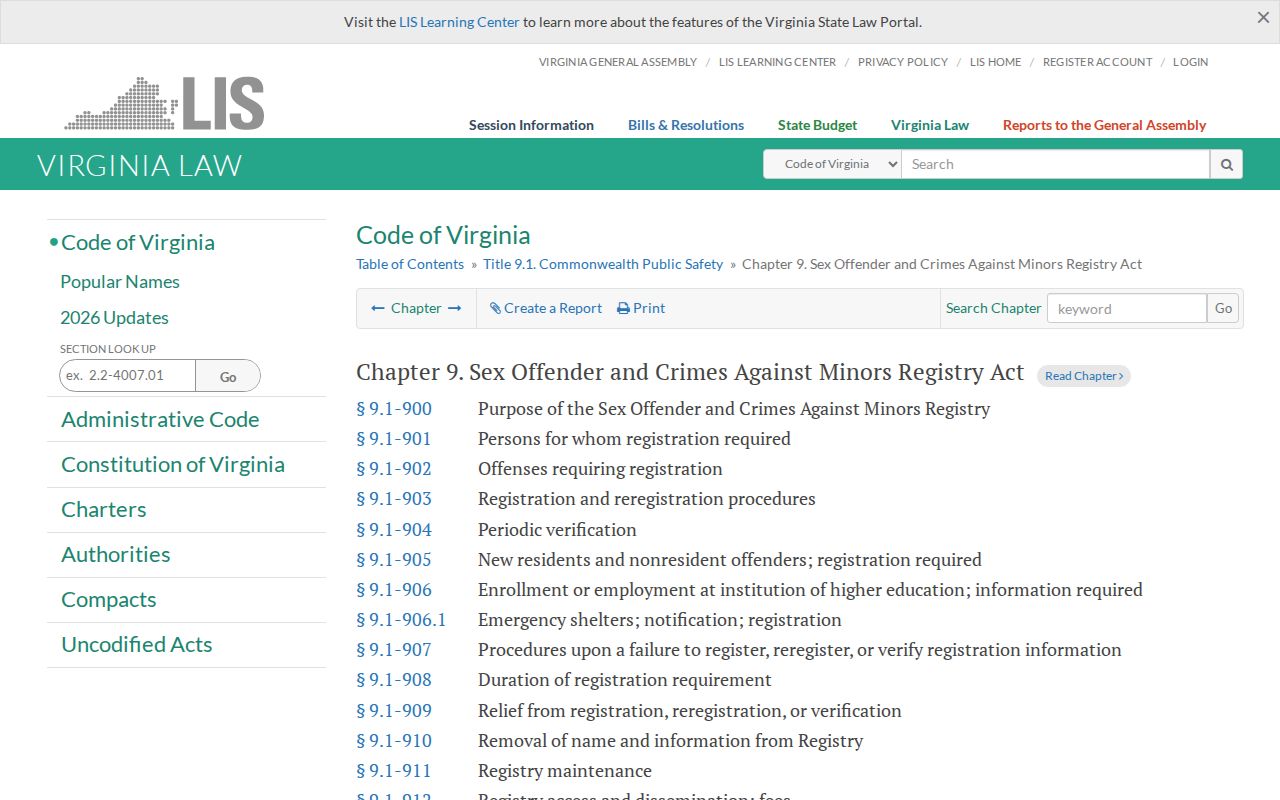
That law, rather than a postal label, controls registry duties and public display.
Note: A county-only result and a Williamsburg city result can differ because postal names and Virginia locality borders do not always match.
Searching the Virginia Sex Offender and Crimes Against Minors Registry
Open the VSP registry and read its displayed conditions before entering a query. The redesigned public interface supports several paths, so the best one depends on what is known. A name search can locate a particular record. An SOR number is more exact. County, city, address, and ZIP fields support community awareness. Search controls and labels may shift with screen size, but the underlying choices remain distinct.
- Open the official VSP registry and review the displayed notice.
- Choose a name, SOR number, address, city, county, or ZIP search that fits the known fact.
- Review the results and use aliases or another location field when spelling or boundaries may affect the match.
- Open the official profile and read status, offense, dates, tier, address data, and verification details as separate fields.
A no-result screen is not a universal certificate. Spelling, a changed name, location, display rules, or update timing may explain the absence. For a known person, try reasonable alias paths offered by the portal. For an address, compare county and ZIP methods. Never substitute a copied commercial list for the VSP record.
| Field Label | Type | Required | Notes |
|---|---|---|---|
| Search mode | Tabs or buttons | Yes | Choose name, SOR number, or geographic search |
| First name | Text | Optional | Combine with the last name for precision |
| Last name | Text | Mode dependent | Spelling and partial-name behavior follow the live interface |
| SOR number | Text | No | State registry identifier |
| Address | Text | No | Street or location input |
| City | Text or select | No | Williamsburg mailing addresses can cross locality borders |
| County | Select | No | Choose James City County separately from Williamsburg |
| ZIP code | Text | No | Useful as a second geographic path |
| Map, list, and results | Interface controls | No | Changes how geographic results are reviewed |
| Search and Clear | Buttons | No | Submits or resets the selected fields |
James City County Registry and NSOPW
The National Sex Offender Public Website adds a nationwide layer. It can help when a person has lived in another state or when a location near James City County draws records from more than one jurisdiction. NSOPW searches participating jurisdictions, but each state still owns its underlying record. Follow a result back to the source registry to review current details and limitations.
The image below comes from the official Department of Justice search and shows the proper cross-state starting point.
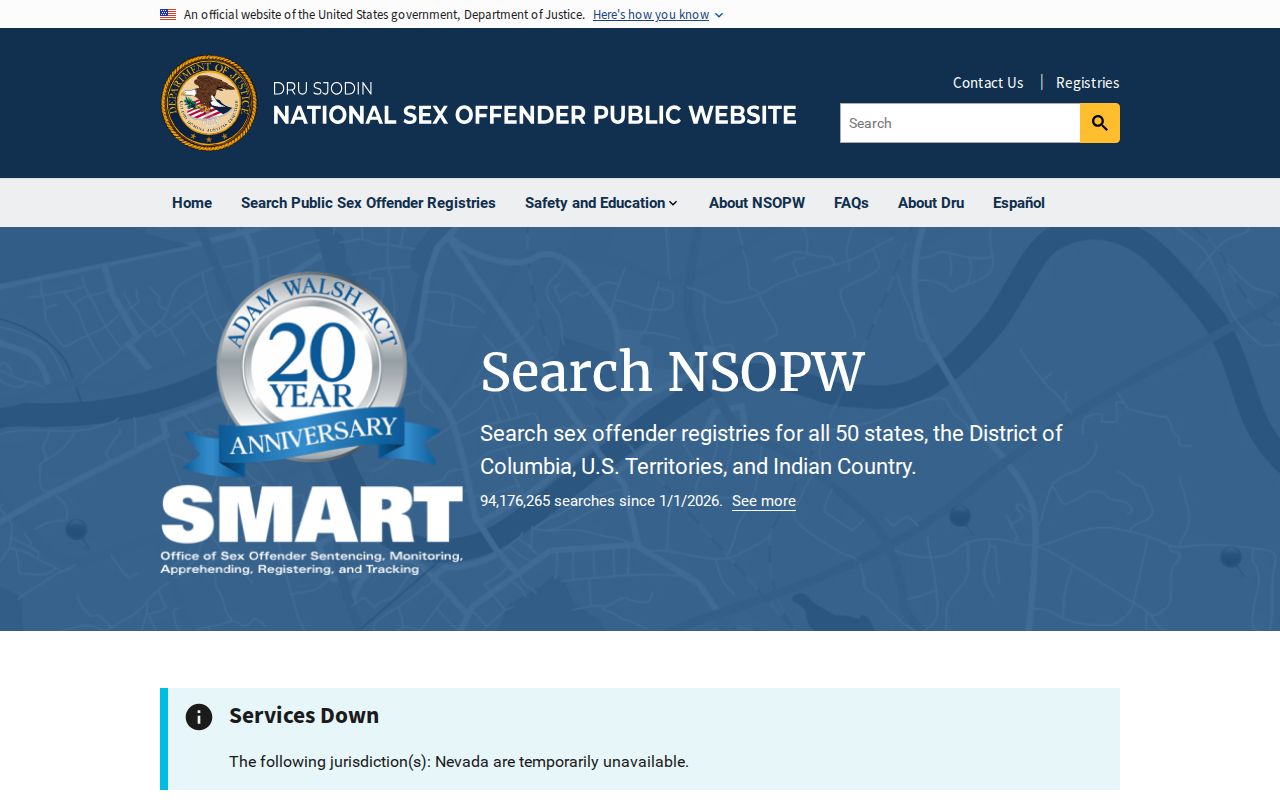
Use the federal layer to widen a search, then rely on the linked state profile for the record itself.
The VSP registry and NSOPW are both free public-notification channels. They are not the same as the mailed, consent-based SP-167 combined criminal-history and registry request. The public registry gives immediate access to legally displayed profiles. SP-167 produces a formal Virginia response after printing, notarization, payment, mailing, and processing.
What a Registry Profile Shows
A Virginia public profile groups identity, location, qualifying offense, and registration data. Read each field for its stated purpose. A current photograph and physical descriptors help distinguish similar names. Alias entries are identifiers, not separate allegations. The listed offense and conviction jurisdiction describe the event that created the duty to register. They do not assert a new offense at the current address.
| Name and Aliases | Displayed names used to identify the registered person |
|---|---|
| Photo and Description | Current photo where published, plus sex, race, age, height, weight, hair, eyes, and identifying marks |
| Registered Locations | Home, work, or school address data only as Virginia law permits |
| Offense and Statute | Qualifying offense, conviction date, and jurisdiction shown by the profile |
| Victim-Age Category | Age category where Virginia law permits publication, without identifying a victim |
| Tier | Offense-based statutory category tied to duties and duration |
| Status and Verification | Registration status and update or verification information reflected by VSP |
| Vehicles and SOR Number | Published vehicle details and the unique state registry identifier where shown |
Some fields may be absent because the law does not authorize public display, not because the underlying fact cannot exist. “Compliant” reflects registry administration at the time shown. It is not a court's character judgment. A wanted or noncompliant label should be verified with law enforcement before anyone relies on it.
James City County Registry Profile Cautions
Dates on a profile are not interchangeable. The offense date, conviction date, registration start, and last verification can all differ. The current address date is another distinct fact. A map marker may be approximate because of geocoding. Work and school information appears only to the extent Virginia law authorizes. Victim-age categories must never be used to identify or investigate a victim.
Physical traits such as scars, tattoos, vehicles, height, and eye color can help resolve a same-name question. They should not be extracted into an unofficial dossier. If a material item seems wrong, record the SOR number and contact VSP. Do not publish an accusation or confront anyone at the displayed address.
Note: Registry tiers measure statutory duties, not a personalized prediction of future conduct or a precise statement of risk.
Registration Requirements and Levels in Virginia
Virginia uses an offense-based tier structure. Tier I generally follows a 15-year pattern, Tier II generally follows 25 years, and Tier III generally requires lifetime registration. Those headlines do not decide one person's end date. Multiple offenses, later convictions, the statutory start point, exclusions, and court orders can change the analysis. Verification frequency also depends on the applicable legal category, so use the current statute and the official profile rather than borrowing another state's rules.
| Tier | General Duration Pattern | Removal Note |
|---|---|---|
| Tier I | Generally 15 years | An eligible person with one Tier I offense may petition no earlier than the statutory 15-year point |
| Tier II | Generally 25 years | Read offense-specific removal rules and exclusions |
| Tier III | Generally lifetime | Excluded from the cited §9.1-910 removal route |
Sections 9.1-902 and 9.1-908 govern offense duties and verification. Section 9.1-910 controls the removal petition described below. The current law matters because a short tier table cannot account for every qualifying offense or prior conviction.
The following images come from Virginia's official felony punishment and misdemeanor punishment sources.
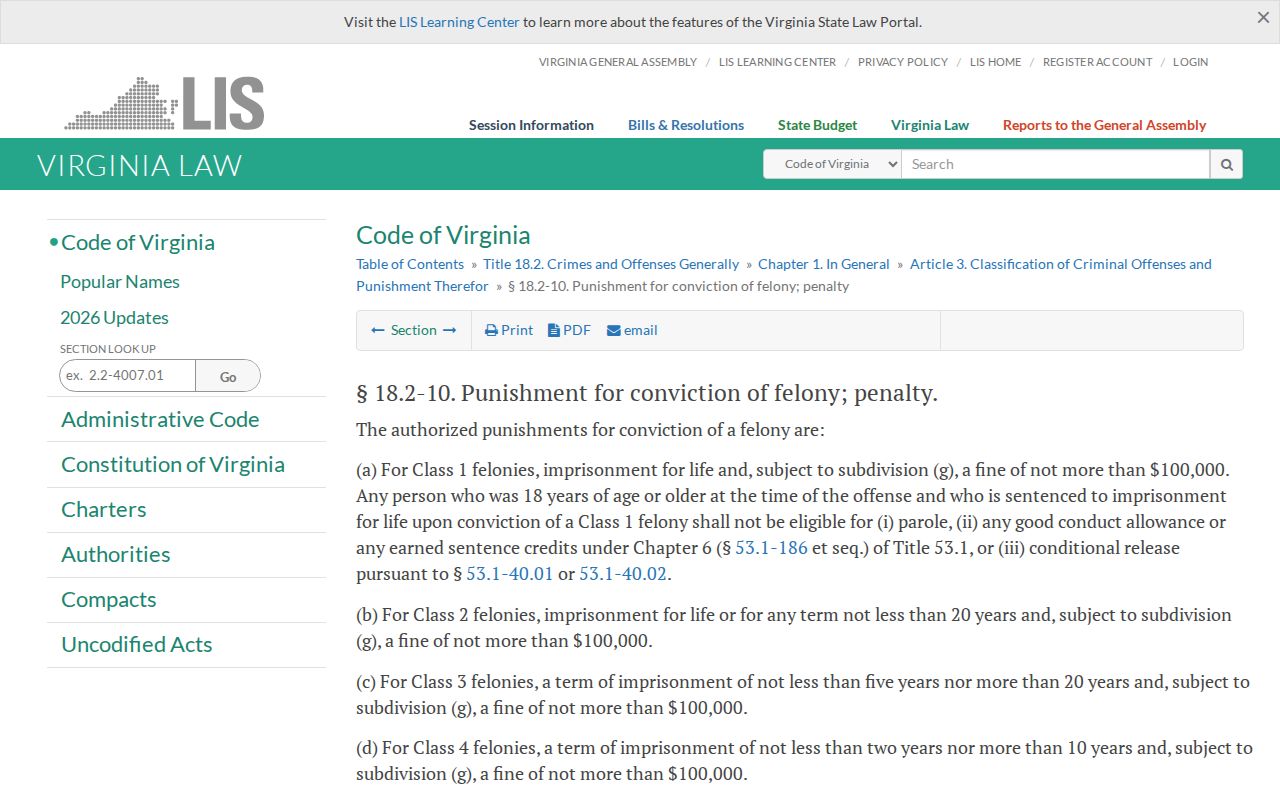
The felony source helps identify the classification attached to a cited Virginia offense. The next image comes from the official Virginia misdemeanor punishment source.
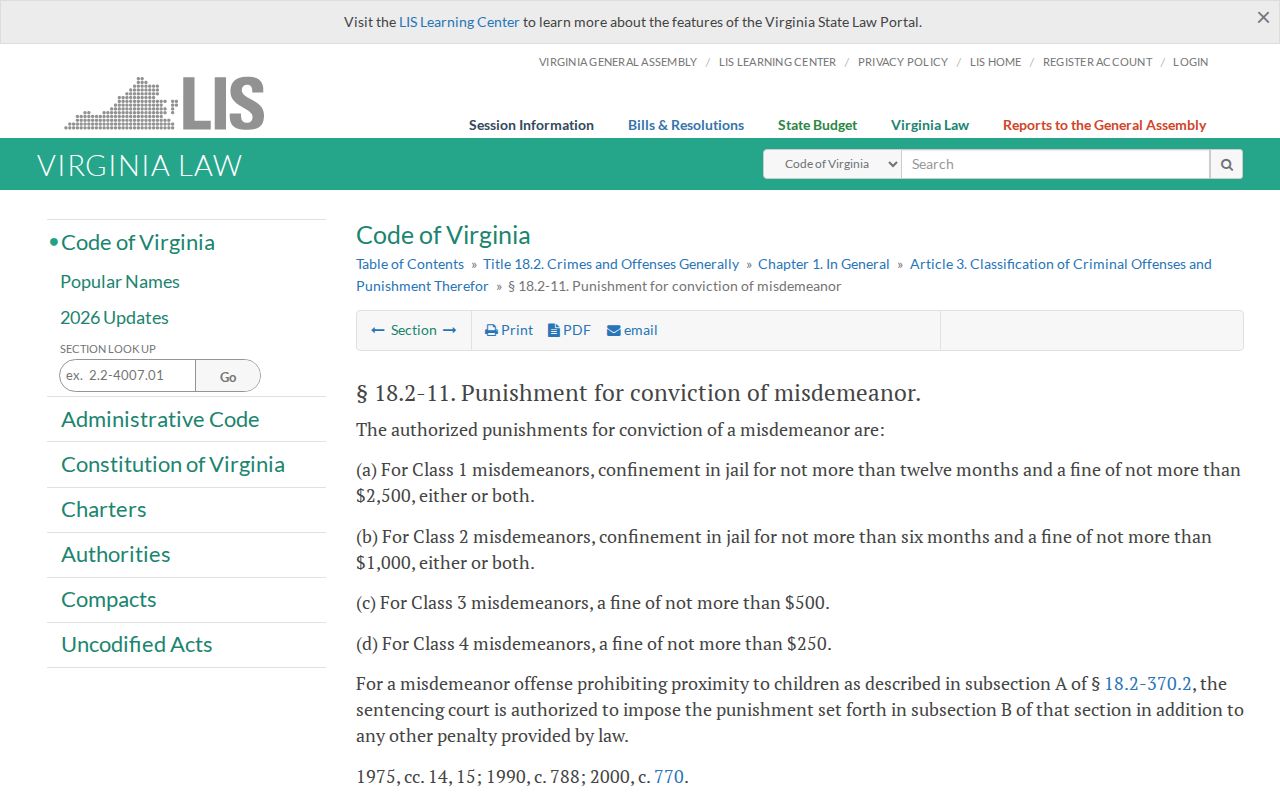
The misdemeanor source supplies the matching lower-offense framework, though the Registry Act still controls registration.
James City County Registry Removal
Removal from the registry is not the same as expunging a court or police record. Under Virginia Code §9.1-910, an eligible person with one Tier I offense may petition no earlier than 15 years after the later statutory starting event. The court reviews the complete criminal history and registration record and holds a hearing. Permission to file does not promise that removal will be granted.
The law excludes Tier III and people with two or more registration offenses from this cited path, along with other listed categories. A personal calculation must use the live law, exact offense, conviction history, and registration dates. Expungement, reversal, pardon, death documentation, or a qualifying removal order can reach VSP through separate procedures. Disappearance from a general court portal alone does not prove the registry duty ended.
The image below comes from the official registry-removal statute.
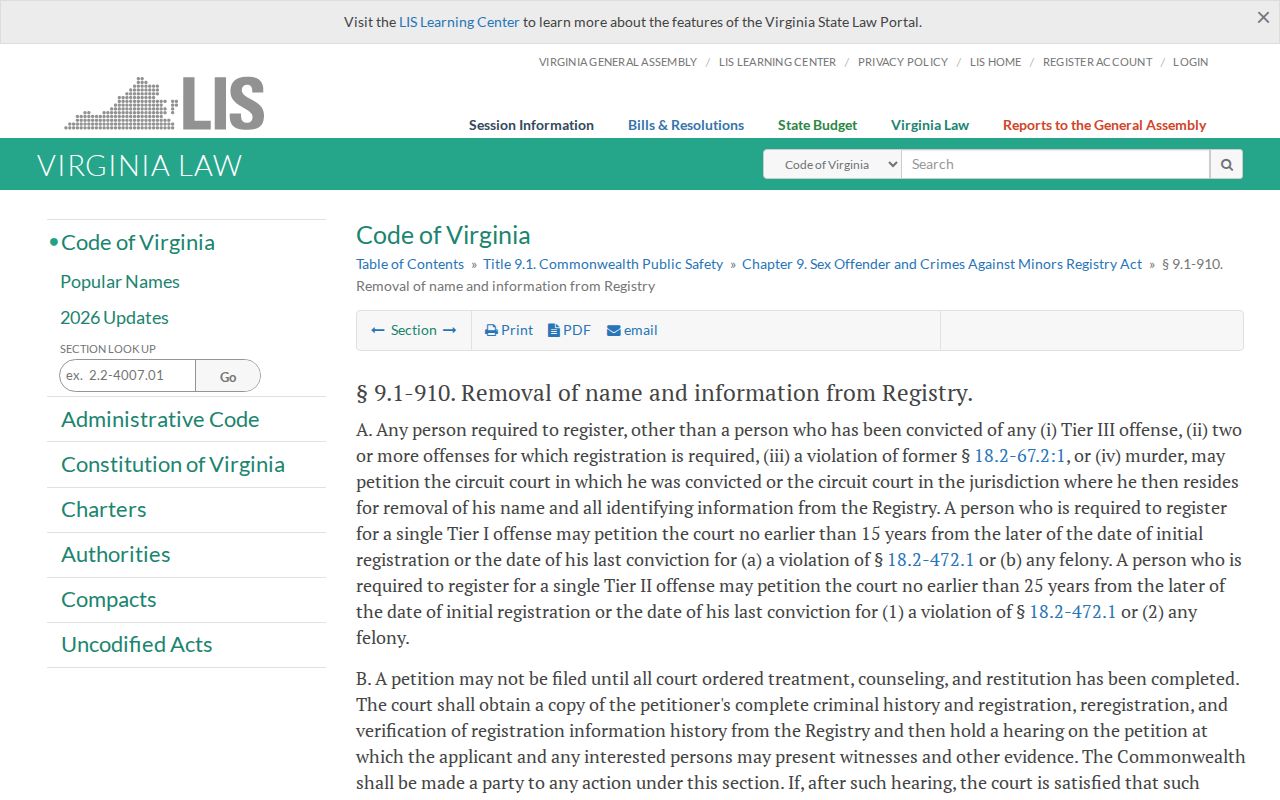
It is the correct source for petition timing and exclusions, subject to the version effective for the case.
Lawful Use and Community Notification
Registry information exists for safety awareness. It can help a person understand official records near a home, school route, family destination, or community site. It does not authorize threats, harassment, trespass, vigilantism, or personal investigation. An address pin is not proof that a new crime occurred, and tier status is not permission to treat the listed person as an immediate threat.
Suspected failure to register should go to James City County Police or the VSP Registry Unit. Share the official profile or SOR number if known. For an urgent threat, call 911. Do not visit the listed address or attempt to enforce a registration rule.
Use the record lawfully: The Virginia Registry Act, §9.1-900 et seq., creates public-notification access. It does not authorize harassment, threats, intimidation, trespass, or other criminal conduct against a registrant or household.
Report James City County Registry Noncompliance
For a nonurgent local concern, use the official James City County Police contact page, call 757-566-0112, or ask Police Records at 757-253-1800 for the current registration contact. The law-enforcement center is at 4600 Opportunity Way, Williamsburg, VA 23188. Confirm an appointment or reporting site before traveling. The courthouse-based Sheriff's Office is not the county Police Department, and the research did not verify the Sheriff's counter as the registration site.
The county's Public Records Request Center supplies a formal route for releasable Police records. Its Courts and Criminal Justice directory distinguishes the Sheriff, courthouse clerks, and Virginia Peninsula Regional Jail from Police Records. None of those offices replaces the VSP public registry.
The VSP Registry Unit can address state profile questions at 804-674-2825 or sor@vsp.virginia.gov. Its mailing address is PO Box 27472, Richmond, VA 23261. When reporting a possible mismatch, give the official SOR number, the profile field at issue, and the reason it appears inconsistent. That is safer and more useful than confronting the listed person.
James City County Police
4600 Opportunity Way
Williamsburg, VA 23188
Records: 757-253-1800
Non-emergency: 757-566-0112
VSP Registry Unit
PO Box 27472
Richmond, VA 23261
804-674-2825
sor@vsp.virginia.gov
Note: Emergencies and immediate threats belong with 911; routine profile questions should go to Police Records or the VSP Registry Unit.